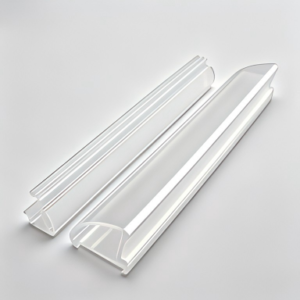
Plastic Extrusion
1.Provides structural support, guiding, connecting, covering, and protective functions 2.Meets different requirements for appearance, dimensions, and assembly structures 3.Supports production from simple profiles to complex functional plastic components 4.Creates stable base parts for punching, printing, laminating, assembly, and packaging
Plastic extrusion is a manufacturing process in which thermoplastic materials are heated, melted, and continuously formed through a die into a specific cross-sectional shape. It is suitable for producing various profiles, structural parts, guide components, decorative trims, and functional plastic parts, especially for products that require consistent cross-sections and stable mass production.
Key Features
- Suitable for continuous-profile products in medium to large volume production
- Capable of forming complex cross-sectional structures
- High production efficiency once tooling and dimensions are stabilized
- Can be combined with secondary processing to improve delivery completeness
- Flexible in designing wall thickness, cavities, slots, rails, and other structural details
Compatible Materials
Typical Applications
Lighting profiles, electrical connection components, architectural trims, industrial guide rails, protective covers, structural supports, and various custom extruded profiles.